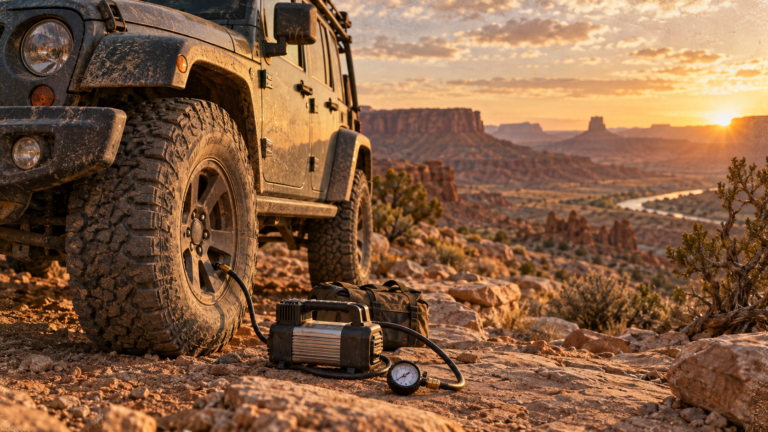
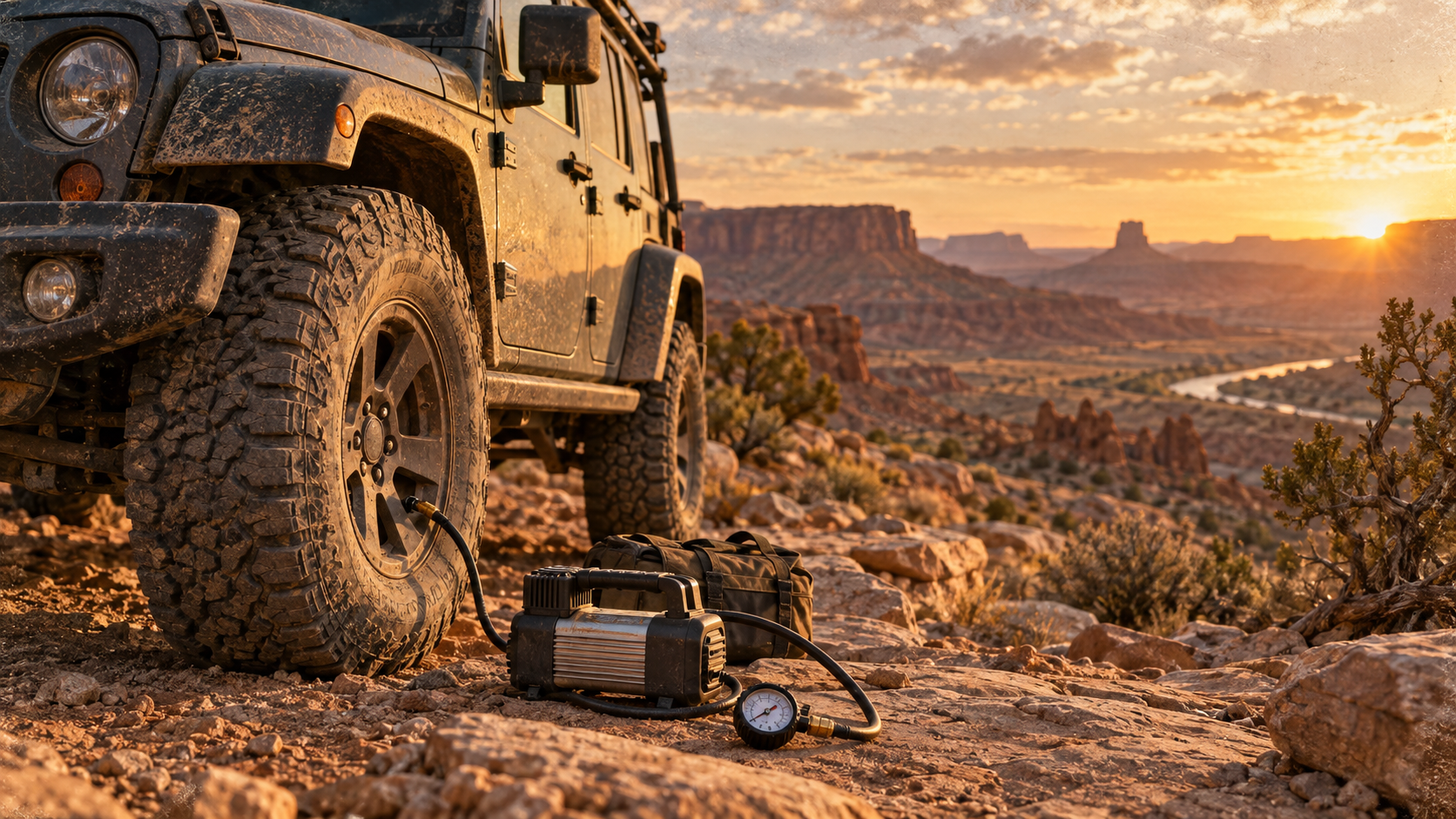
Your first off-road trip does not require a dramatic tire-pressure change. It does require knowing the right pressure for the drive there, deciding whether the trail calls for a change, and having a way to put the air back before you drive home. Here is a pressure routine you can use without treating someone else’s PSI as a rule for your Jeep.
As an Amazon Associate I earn from qualifying purchases. Some product links in this article are affiliate links.
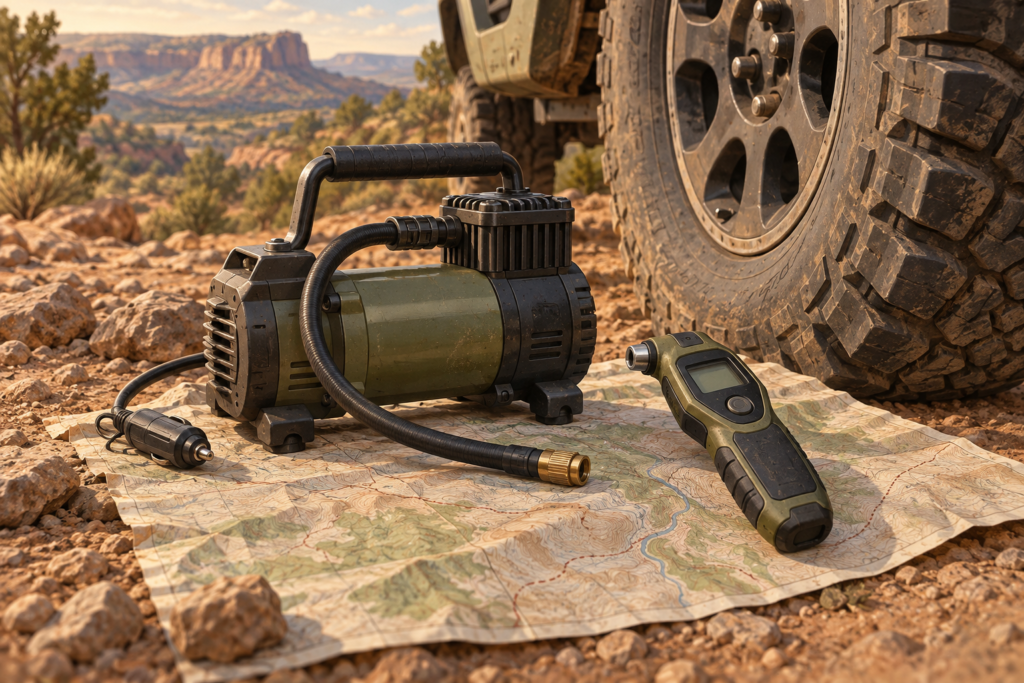
For a repeatable reading, compare a dedicated AstroAI digital tire-pressure gauge with the gauge you already carry. If your route calls for airing down, a VIAIR 88P portable compressor is one portable model to evaluate against your tire size, power connection and inflation workload.
Start with your on-road pressure
Find the Tire and Loading Information label on the driver’s door edge or doorjamb, or consult your owner’s manual. For a vehicle on its specified tires, that is where you find the manufacturer’s recommended cold pressures; front and rear values may differ. The PSI molded into a tire’s sidewall is a maximum, not your vehicle’s recommended road setting. NHTSA explains the label and pressure checks.
“Cold” means the vehicle has not been driven for at least three hours. Check all four tires with a gauge before leaving, and check the spare if you have one. Write down the appropriate front and rear road pressures so you have a clear target when the trail ends. NHTSA recommends checking tires, including the spare, at least monthly and warns that a tire-pressure monitoring system (TPMS) is not a substitute for a gauge: its warning generally comes on only after substantial underinflation. See NHTSA’s tire-pressure guidance.
If the tires or wheels differ from the vehicle’s specified setup, do not assume the original door-label pressure or an online off-road number settles the question. BFGoodrich notes that replacement tire sizes and types can have different load and inflation requirements and advises consulting a tire professional about the appropriate on-road pressure. Read BFGoodrich’s tire-selection guidance.
What airing down can do
Verified: “Airing down” means lowering tire pressure for off-road travel. It can enlarge the tire’s contact area and improve traction or ride comfort on soft or uneven ground. It is not a requirement for every dirt road. Jeep discusses the potential benefit, while BFGoodrich emphasizes that the useful pressure depends on tire type, terrain, and vehicle weight. See Jeep’s off-road overview and BFGoodrich’s pressure guidance.
Editorial judgment: For a first outing on a firm, uncomplicated trail, keeping the correct on-road pressure may be the simpler choice. Learn what the surface is like before changing a setting you will have to restore. Soft sand is a clearer reason to consider airing down than an ordinary graded access road, but neither surface supplies a universal PSI.
Do not borrow a number without its context
Jeep’s general beginner guide describes 15–25 psi as a broad off-road range. Separately, the US-market 2022 Wrangler driving guidance says that, for large soft sandy areas or dunes, pressure can be reduced to a minimum of 15 psi. That manual also says to reinflate before pavement and warns that reduced pressure can unseat a tire and cause a complete loss of air. These are descriptions of different scopes of guidance, not permission to set every Jeep to 15 psi. Read Jeep’s general guide and the 2022 Wrangler driving guidance.
Editorial judgment: Read the guidance for your own model and tire setup before using a numeric example. If you cannot establish an appropriate trail pressure—particularly with changed tires or wheels, a heavy load, or unfamiliar soft terrain—ask a qualified tire professional or experienced trip leader rather than guessing. You can choose an easier route instead.
Prepare before you reach the trail
- Bring a pressure gauge. Use it for actual readings rather than judging a tire by its appearance or waiting for the TPMS light. NHTSA recommends gauge checks.
- Have a workable reinflation plan. If you intend to air down, bring a suitable source of air, such as a portable compressor that matches your tires, and know how you will use it. The Wrangler guidance says to have a way to reinflate before reducing pressure.
- Inspect the tires and spare. Look for visible cuts, bulges, or other damage before depending on them off-road. BFGoodrich recommends inspections before and after trail use and carrying a spare. See its trail-preparation advice.
- Note the route home. Identify where the trail meets pavement or another hard surface; plan to stop and restore road pressure before crossing that boundary, not miles afterward. Jeep’s Wrangler guidance makes that distinction explicit.
A restrained trailhead routine
Editorial judgment: If your vehicle-specific guidance and trail conditions support airing down, use this as a checking process—not as a prescription for how many PSI to remove.
- Stop in a suitable place before the soft or rough section. Measure each tire and record its starting pressure. Confirm your air source is available before releasing air.
- Lower pressure deliberately with a deflator or gauge, checking each tire rather than relying on elapsed deflation time. Follow an appropriate target for your setup; do not substitute the Jeep examples above for one.
- Drive slowly and avoid sharp turns or abrupt maneuvers. The Wrangler manual specifically associates those actions at reduced pressure with a risk of tire unseating.
- Recheck pressures if the vehicle’s behavior changes or a tire looks suspect. If the TPMS warns, stop where appropriate and measure; do not dismiss the warning merely because you intended to air down. NHTSA explains what a TPMS warning means.
Air up before you drive out
At the end of the off-road section, stop and reinflate before returning to pavement or another hard surface. Check each tire with the gauge, including any front-to-rear difference in your appropriate road settings. BFGoodrich warns that driving on pavement with off-road-reduced pressure can impair handling, increase wear, and cause excess heat. See BFGoodrich’s air-up guidance.
A tire measured after driving is warm, while the door-label recommendation is a cold value. NHTSA advises that, if a driven tire is underinflated, filling it to the label’s cold pressure is preferable to continuing substantially underinflated; then recheck and adjust when the tires are cold. Do not mistake a warm reading for a new cold-pressure specification. Read NHTSA’s warm-tire instructions. Before the next trip, inspect the tires again and check pressures cold.