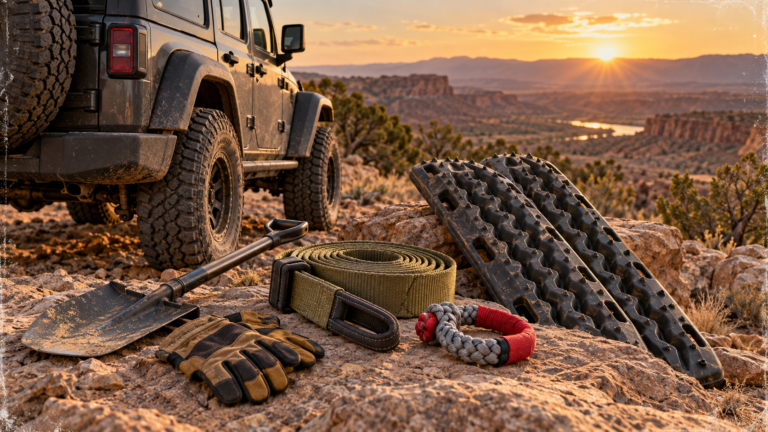
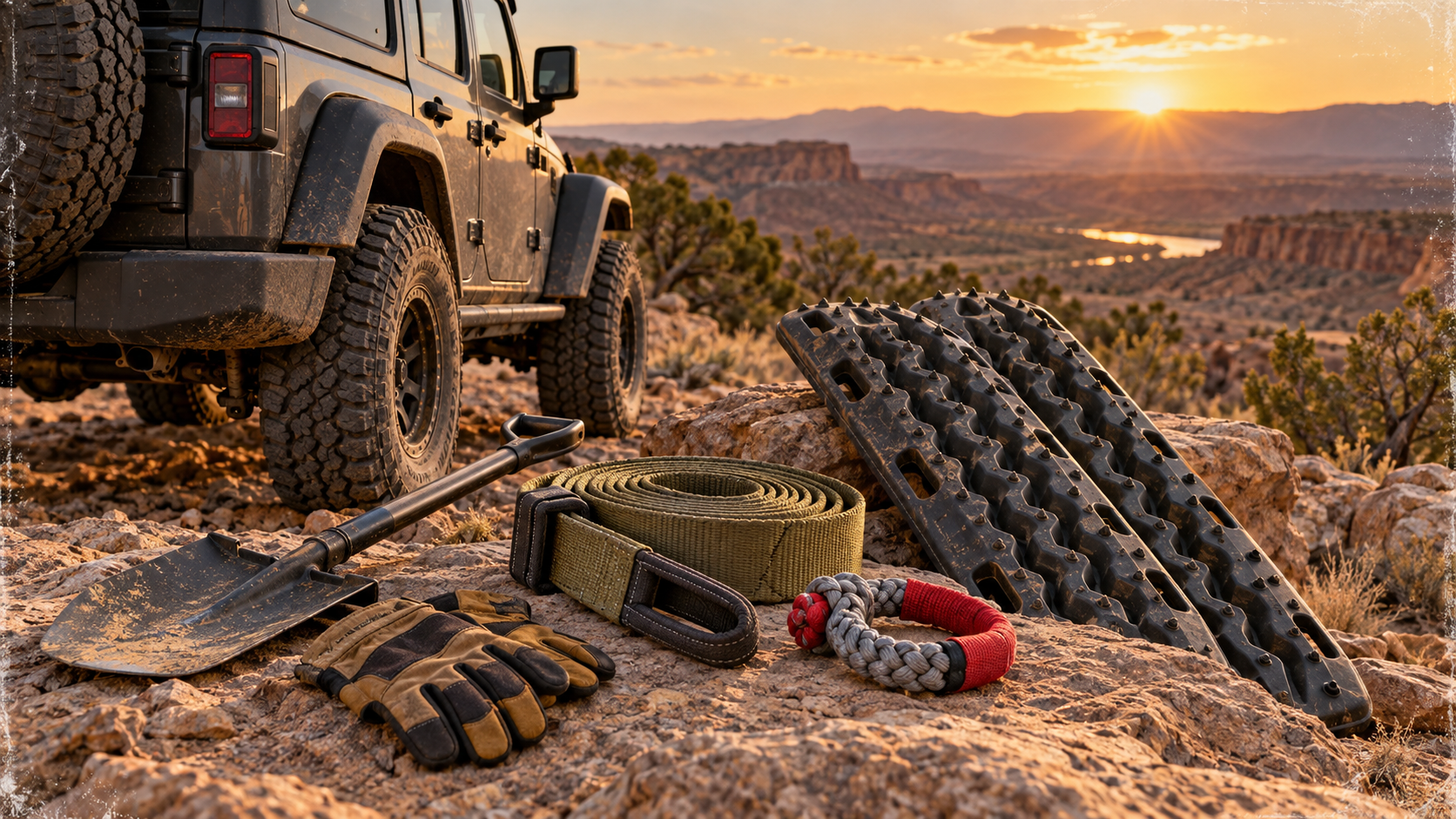
A recovery board is useful only if your tire can grip it and you can reach it when the Jeep is stuck. That makes tire tread a better starting point than a photo of boards mounted on a roof rack. The MAXTRAX MKII Black Recovery Boards are relevant to drivers who expect soft sand, mud, or snow on permitted 4×4 routes and want a way to attempt a gentle self-recovery. They are not a reason to drive farther into trouble.
As an Amazon Associate I earn from qualifying purchases. Some product links in this article are affiliate links.
First check: what tires are actually on your Jeep?
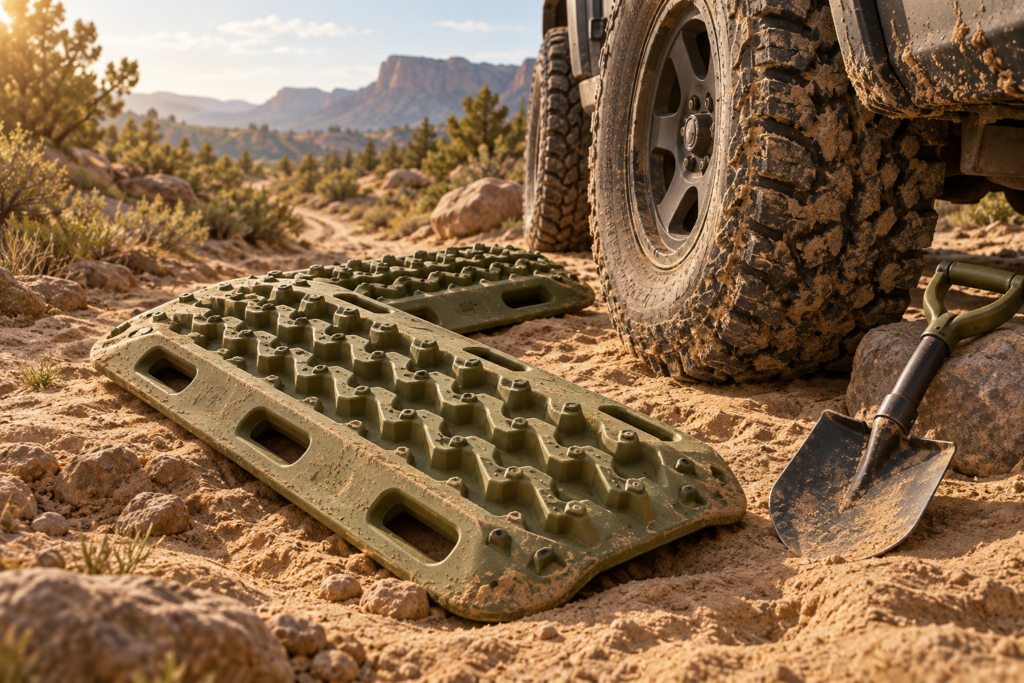
Verified product guidance: MAXTRAX says its raised teeth are designed to engage the open tread of all-terrain or mud-terrain tires. It advises against using the boards with highway-type tires: their narrower, shallower grooves may fail to engage the teeth, allowing wheelspin that can damage the boards. That is a more useful buying distinction than Jeep model or tire diameter alone.
Buying judgment: Look at the tires currently fitted, not the tires you plan to buy later. If they are highway-oriented, put tire choice and route planning ahead of this purchase. An all-terrain label is not a promise of recovery, either. Worn tread, buried underbody parts, or a surface too firm for the boards can change the outcome. If you cannot tell what tires you have, read the sidewall and identify the exact tire model before treating boards as a solution.
Second check: does your route suit a traction board?
MAXTRAX’s instructions describe a specific use: clear obstructions around the tires and beneath the vehicle, wedge a board firmly against each relevant tire in the direction of travel, keep people clear, and apply gentle power without spinning the wheels. The manufacturer warns against using MKII boards on hard, rocky surfaces, as a bridge or ramp, or below minus 20 degrees Celsius. A board can help a tire find purchase; it cannot repair a tire, make an impassable route passable, or lift an underbody that is resting on an obstacle.
That distinction matters on mixed overland trips. Soft beach access or a muddy campsite exit gives the boards a plausible job. A rocky ledge or deep rut may demand a different decision: stop, reassess the line, and avoid forcing a recovery method the manufacturer rules out. If the Jeep has stopped moving, repeatedly adding throttle can dig it in deeper. The National Park Service gives the same warning for sand and mud.
Before packing for a beach or public-land trip, check that vehicle travel is permitted on the intended route and learn its conditions. Cape Lookout National Seashore, for example, advises drivers to check weather and tides and carries traction boards on its suggested off-road equipment list. Its guidance is specific to that park, not a universal permission to drive on beaches.
Third check: where will a full-size pair live?
MAXTRAX lists each MKII board at approximately 45 inches long and 13 inches wide, with a pair weighing about 15 pounds. Measure an actual storage location with the Jeep packed for a trip. A board that fits an empty cargo floor may block the cooler, interfere with a sleeping setup, or end up underneath everything you need to unload before reaching it. Leave room to retrieve the pair while the vehicle is stationary and stuck, not just while loading at home.
If you plan an exterior mount, verify your rack or carrier’s capacity and the attachment method rather than assuming that the boards’ accessory holes fit what is already on your Jeep. MAXTRAX publishes separate mounting-pin instructions and tells installers to check measurements against their actual boards before drilling. A securely planned mount is more useful than an attractive one that obstructs access or invites an improvised attachment. Interior storage avoids a mount but calls for a plan for containing sand or mud after use. Neither choice is automatically right for every Jeep.
Fourth check: what does the exact offer include?
The MAXTRAX MKII Black manufacturer page describes a carton with two boards and two orange retrieval leashes. The saved Amazon listing identifies the product as the MKII Black and also lists two boards and two leashes under included components. Before ordering, confirm that the selected offer is for the pair, not a replacement part or a different board variant, and check the included-components description. Do not assume a mounting kit or carry bag comes with the boards.
The leashes have a practical role: boards can become buried during a recovery, and MAXTRAX says the leashes help locate them. Plan to retrieve both boards before leaving. If your purchase depends on a particular mount, confirm its compatibility and contents separately; a photo of a roof-mounted pair is not a parts list.
Keep the rest of the plan ahead of the boards
For soft sand, boards make more sense alongside a shovel, a tire-pressure gauge, and a way to reinflate tires when appropriate. Cape Lookout’s equipment guidance includes those items as well as traction boards. Its tire-pressure advice is for its own beach conditions; use guidance appropriate to your vehicle, tires, and route rather than copying a single pressure number. If you air down, plan how to restore normal road pressure before the paved drive home. The tire-pressure gauge guide and portable-compressor listing checklist address those separate buying decisions.
Read the MAXTRAX instructions before the trip. In particular, they call for clearing debris, placing boards firmly against the tires, moving gently, and stopping to reposition them if the tires do not engage. Wheelspin can damage the traction teeth and make the vehicle harder to free. Keep people away from the vehicle’s path. If the situation is beyond a controlled self-recovery, stop and seek appropriate help rather than treating another attempt as mandatory.
When to skip the MKII pair
Skip it for now if your Jeep wears highway tires, your trips stay on pavement or maintained firm roads, you cannot stow or mount the pair properly, or your expected obstacle is mainly hard rock. Also wait if the boards would consume the budget for a gauge, reinflation plan, basic supplies, or learning the vehicle. For a broader comparison with assisted recovery equipment, see Recovery Boards vs. Rope for a First 4×4 Trip; the two tools do different jobs.
The buying test is straightforward: suitable tread, genuinely soft terrain, accessible storage, and a complete plan around the boards. If one of those is missing, solve that problem first. If all four check out, the MKII Black pair has a defined role in a beginner’s Jeep kit without pretending it can solve every stuck-vehicle problem.