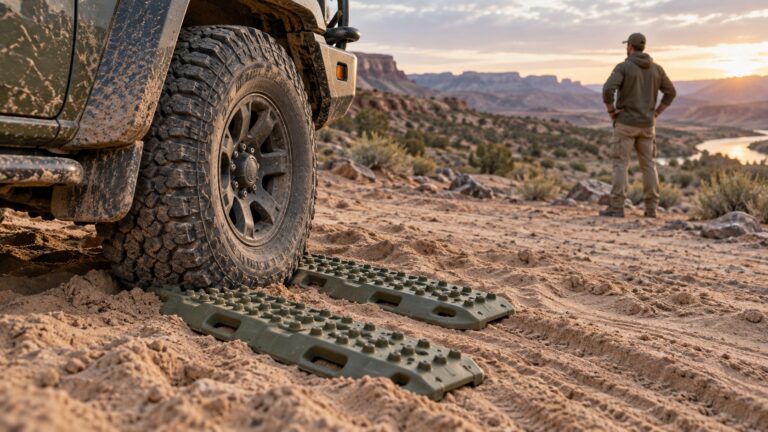

At the end of a trail day, the useful question is not whether a compressor can hit a dramatic maximum PSI. It is whether you can connect it to your Jeep, reach every tire, and restore the pressure your road setup calls for before you drive home. The VIAIR 88P portable compressor is a compact way to build that routine if your tires and power setup fit its published limits. The rest of the kit should make the process easier to measure, reverse, and manage when something goes wrong.
As an Amazon Associate I earn from qualifying purchases. Product links in this story may earn Rústiko a commission, at no extra cost to you.
Where the 88P makes sense
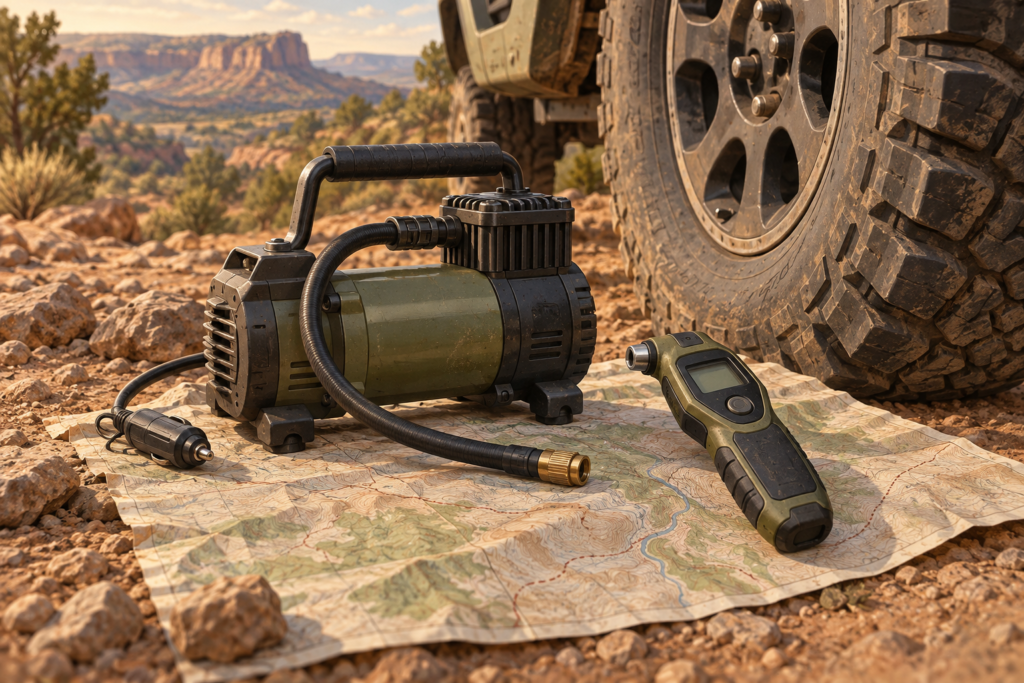
VIAIR rates the analog 88P, part 00088, for tires up to 33 inches. It runs on 12-volt power through clamps attached to the vehicle battery, rather than a cabin accessory outlet. The manufacturer lists a 20-amp maximum draw, a 10-foot power cable, and a 16-foot air hose. Those details make it a candidate for a Jeep whose tire size is within that range and whose owner wants a portable unit that can be stored between trips.
The rating is a starting point, not a promise about how quickly four tires will fill. A long wheelbase, a rear-mounted spare, cargo gear, and the place where you can safely set the compressor all affect whether those published lengths work for your Jeep. Before buying, picture the actual path from your battery to the farthest valve and check the exact part number on the listing. The 88P name also appears alongside newer variants, so the instructions for one version should not be assumed to cover another.
Build the routine around a reliable reading
The 88P has a built-in analog gauge, but its manual says to switch the compressor off before reading it because air flowing through the system affects the indication. A separate AstroAI digital tire-pressure gauge gives you a dedicated tool for checking each tire before and after the change. Keep one gauge as your consistent reference, check the spare too, and use the pressure guidance for your vehicle and tire setup. For an unmodified setup, the vehicle placard or owner’s manual gives the recommended cold road pressure; the maximum number on the tire sidewall is not that target.
If a route and your equipment call for airing down, make that an intentional, measured step rather than letting air out by feel. An ARB E-Z Deflator Kit is one way to control and check the change at each tire. There is no universal trail PSI in this article: tire construction, load, wheels, terrain, and vehicle guidance matter. The compressor earns its place on the return leg, when you need to get back to the appropriate road pressure before pavement.
What the compressor does not solve
Air is useful only if the tire can hold it. A JACO TRX-50 tire repair kit can be a practical backup for a suitable tread-area puncture, alongside a serviceable spare and the tools to change a wheel. It does not make every puncture repairable: sidewall damage, major cuts, a tire that has been driven flat, or an uncertain repair needs professional assessment. Treat a trail repair as a way to manage the immediate situation, not a substitute for proper inspection and service.
Nor can the 88P ignore its operating limits. VIAIR gives it a 25-minute duty-cycle specification at 30 PSI and warns that the unit becomes hot during use. The manual calls for the engine to be running while the battery clamps are connected, keeping the unit dry, placing it on a firm surface, and letting it cool before storage. If you regularly reinflate larger tires or several vehicles in one stop, compare a higher-capacity compressor or an onboard-air system against that workload instead of assuming the 88P will be comfortable simply because it can reach your tire’s pressure.
The five-minute test before the first trip
Lay out the compressor, gauge, deflator, and repair supplies at home. With the Jeep parked safely, confirm that the power cable and hose reach all four tires and the spare, that you know how to attach the clamps as the manual directs, and that the gauge is easy to read with the pump stopped. Practice storing the hot unit only after it cools. Make a note of where every valve cap, fitting, and cord goes; those small parts are harder to find at dusk beside a trail.
For occasional trips on tires within VIAIR’s stated range, the 88P can be the center of a compact air-up kit. The gauge makes the result measurable, the deflator makes any planned air-down more controlled, and the repair kit covers a limited class of puncture emergencies. If your tires exceed the rating, the hose cannot reach, or repeated inflation will push against the stated operating limit, choose the compressor from those needs first. You can review the 88P gear notes for the exact model and keep this article as a checklist for the complete routine.